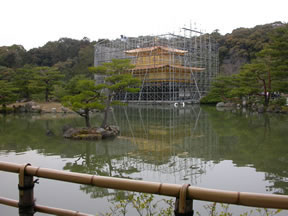
Rokuon-Ji Temple
Kinkaku (Golden Pavilion) is a popular name for one of the main buildings of this temple, which is properly called Rokuon-Ji Temple. In the 1220's it was the comfortable villa of Kintsune Saionji.
Yoshimitsu, the 3rd Shogun of Ashikaga, abdicated the throne in 1394. After three years he began to build Kitayamaden and he made a special effort to make it a breathtaking site. He indulged in his peaceful life in this serene setting. After Yoshimitsu's death, Kitayamaden was made into a Zen temple in accordance with his will. All the buildings of those days came to ruin except Kinkaku. The garden, however, remains as it was in former days and can be enjoyed as it was hundreds of years ago. Rokuon-ji Temple was inscribed as World Cultural Heritage in 1994.
Kinkaku was formally called Shariden. The elegant, harmonious building consists of three types of architecture. The 1st floor is Shinden-zukuri, the palace style. It is named Ho-sui-in. The 2nd floor in Buke-zukuri, the style of the samurai house and is called Cho-on-do. The 3rd floor is Karayo style or Zen temple style. It is called Kukkyo-cho. Both the 2nd and 3rd floors are covered with gold-leaf on Japanese lacquer. The roof, upon which the Chinese phoenix settles, is thatched with shingles.
This information was taken from the pamplet
"The Golden Pavilion-Rokuon-Ji Temple"
provided to us at the entrance of the temple.