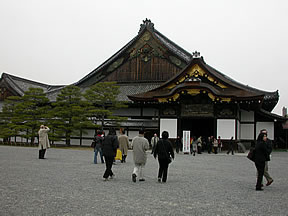
Nijo Castle
The castle was originally built in 1603 to be the official Kyoto residence of the first Tokugawa Shogun Ieyasu, and it was completed in 1626 by the third Shogun Iemitsu, who transferred some structures from Fushimi Castle, built in the Momoyama Period (1573-1614). Consequently, lavished decorated Nijo Castle is representative of the height of Mamoyama architecture. In its day, it served as a symbol of the power and authority of the Tokugawa military government.
When Yoshinobu, the fifteenth Tokugawa Shogun, returned sovereignty to the Emperor in 1867, the Castle was given to the Imperial family. In 1884 it was renamed Nijo Detached Palace and in 1939 donated to the City of Kyoto renamed Nijo Castle (nijo-jo) and opened to the public.
The total area of the Castle is 275,000 square meters; 7,300 square meters are occupied by buildings.
The innermost chambers of the Ninomaru Palace served as the Shogun's living quarters. The paintings on the walls and sliding doors were exucuted by Kano Koi (d. 1636). The modest and quiet mood of these mountain and water scenes served to create a relaxing atmosphere for the Shogun's daily life. The unique point of these chambers is the fact that only female attendants were allowed entry here.
This information was taken from the pamplet "Nijo Castle" given to us at the entrance of the castle.