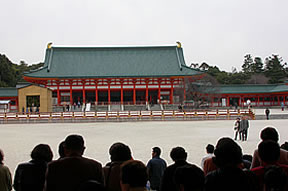
Emperor Kanmu was born in 737 as the crown prince of Emperor Konin, and ascended to the throne in 781 as the 50th Emperor of Japan. Realizing that the capital of heijo was small in scale and beneath the dignity of our country, Emperor Kanmu transferred the capital to Nagaoka in the province of Yamashiro and further picked the adjoining countries of Kadono and Atago in 793 as the best possible site for the capital, and began constructing the new palace. In the following year, the seat of the Government was moved to the new capital called the Heian Capital.
At the turn of 796, the Emperor received in audience the dignitaries to celebrate the New Year for the first time at the Daigoku-den Palace.
This marked the beginning of Kyoto.
During his 25-year reign, Emperor Kanmu amended the laws and ordinances, gave relief to the destitute, encouraged learning, innovated the domestic administration, and opened the doors to the foreign trade thereby contributing to the development of the country. Ever since up till the Meiji Restoration, Kyoto prospered as the capital of Japan for more than 1,000 years.
The 50th ruler demised in 806 and was entombed at the Kashiwara Mausoleum in Momoyama, Fushimi-Ku, Kyoto.
The year 1895 happened to be the 1,100th year since the Heian Capital came into existence. Marking thiscommemorative year, the citizens of Kyoto decided to praise the virtues of Emperor Kanmu and deify him as the ancestral god of Kyoto. To this end, they restored the style of Chodo-in, the main edifice of the Heian Capital, solemnizing the dedication of the shrine of March 15, the same year. Emperor Komei was born in 1831 as the crown prince of Emperor Ninko and acceded to the throne in 1847 as the 121st ruler of Japan.
Though brief, his sovereignty lasting for 21 years spelled the quickening period of the modern Japan, an era marking the closing days of the Tokugawa Shogunate. Well cognizant of the turbulent times, the gifted ruler laid the firm foundation of the Meiji Restoration. The emperor passed away on December 25, 1866 at the young age of 36, ending his life characterized by his intense patriotic concern for the welfare and destiny of the country.
The Imperial tumulus known as Gotsukinowa Higashiyama Mausoleum is located at Sennyu-ji Temple, Higashiyama-ku, Kyoto.
In adoration of the great character and achievements of the Emperor who laid the foundation of the modern Japan, the citizens of Kyoto organized a body to deify Emperor Komei at the Heian Shrine in 1938 which propelled the move to rebuild the shrine as a commemorative project marking the 2600th year of founding of Japan. The dedication ceremony took place on October 19, 1940.
This is how the two Emperors of Japan, the one as the founder and the other as the last ruler of the Heian Capital, have come to be deified at eh Heian Shrine. Today, it does not only figure as a tourist attraction of foreign visitors but also features as the spiritual center of the nation as a whole as well as of the patriotic citizens of Kyoto.
This information was taken from the pamplet "Brief History Heian Shrine" that was given to us at the shrine entrance.